

Improving Grain Quality with Batch Grain Dryers
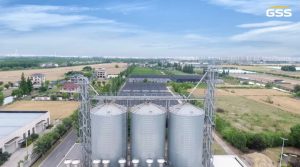
During the summer harvest season, volatile and rainy weather poses a significant threat to grain farmers. Traditional open-air sun-drying is limited by space and weather, making crops highly vulnerable to mold, germination, and quality degradation. Batch grain dryers, with their unique structural engineering and intelligent control systems, provide a robust guarantee for grain safety and quality during the harvest.
1.Why Batch Grain Dryers are the Best Choice for Summer Harvest
Summer crops such as paddy rice and wheat require extremely precise temperature control and uniform moisture management during drying. Compared to traditional drying methods or continuous drying systems, batch circulation drying technology offers irreplaceable advantages in preserving grain quality:
1.1 Low-Temperature Tempering Ensures Grain Quality
- Reducing Cracked Kernel Rate:Operating under a “drying-tempering-drying” cyclic mode, heated grains move into a tempering section where internal moisture migrates to the surface before re-entering the drying zone. This is ideal for heat-sensitive grains like rice, effectively preventing head rice yield drops and stress cracking caused by rapid high-temperature dehydration.
- Preserving Taste Quality & Germination Rate: Precise control of temperature and exposure time preserves the culinary flavor and seed germination rate to the maximum extent, driving higher market premiums.
1.2 Automatic Stepped Temperature Control & Smart Moisture Monitoring
- Gradient Temperature Control: The system automatically adjusts hot air temperatures in steps based on initial moisture content. Higher temperatures are applied in early dehydration stages, shifting to lower temperatures later for gentle moisture reduction.
- Precision Shutdown:Integrated automatic moisture sensors, level indicators, and real-time grain/air temperature monitoring automatically cut off heating or signal alerts upon reaching target moisture levels, preventing loss from over-drying.
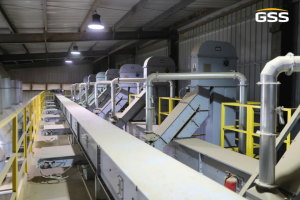
2.Case Study: Indoor Batch Grain Dryer at Taicang Fengyuan Farm
Located in Yongfeng Village, Taicang City, Jiangsu Province, the 240 MTPD (metric tons per day) grain drying center retrofit project undertaken by GSS Systems has been successfully completed. As the core equipment of this project, the GSS-BD series indoor batch grain dryers—installed inside a modern facility—safeguard local grain security through advanced engineering and smart automation.
Technical Features & Deployment:
- Covers intake pit reception, impurity cleaning, GSS-BD indoor batch drying, and truck dispatch/silo storage.
- Paired with air-source heat pumps featuring zero open flames, eliminating fire hazards while reducing operational costs compared to natural gas.
- Dedicated negative-pressure air suction ports installed at intake pits and bucket elevator transfer points prevent dust dispersion.
- Integrated exhaust gas treatment, dust/chaff collection, and central electrical controls enable fully automated indoor management.