

What Is a Grain Bin, and What Is It Used For?
A grain bin is a weather-tight, engineered structure that holds harvested grain at controlled moisture and temperature until it is dried, sold, processed or shipped. It is not a passive container: grain is a living material that respires, and a working bin is a managed environment of structure, airflow, sensing and handling equipment that keeps a biological product stable for weeks or months. Bins are used to buffer harvest, hold wet grain before drying, equalise moisture after drying, preserve quality over long storage, keep lots separate, and stage grain for load-out.
1. What Exactly Is a Grain Bin?
Most modern bins are bolted, corrugated galvanised-steel cylinders on a concrete foundation, with a shallow conical roof, roof vents and a centre fill opening. Inside, a raised perforated floor sits above an air plenum; a fan pushes or pulls air through that floor and up through the grain mass. Temperature cables hang from the roof, a sweep auger lies on the floor, and an unloading point feeds a conveyor or a bucket elevator.
Think of a thermos rather than a bucket. A bucket only holds things. A bin has to slow down biology: moulds, insects and the kernels themselves consume oxygen and release heat, carbon dioxide and water. Storage is the job of keeping that activity slow enough that quality does not change before the grain moves on.
Three terms are routinely mixed up:
| Term | What it usually means |
|---|---|
| Grain bin | A bolted steel, flat- or hopper-bottom structure, typically on-farm or at a depot; roughly 1,000–50,000 bushels |
| Grain silo | A taller, usually concrete or smooth-wall steel structure built for mass flow and high throughput; terminal silo banks can reach around 1,000,000 bushels |
| Grain elevator | Either the entire facility (receiving, drying, storage, load-out) or the bucket elevator machine that lifts grain vertically — the trade calls that machine a “grain leg” |
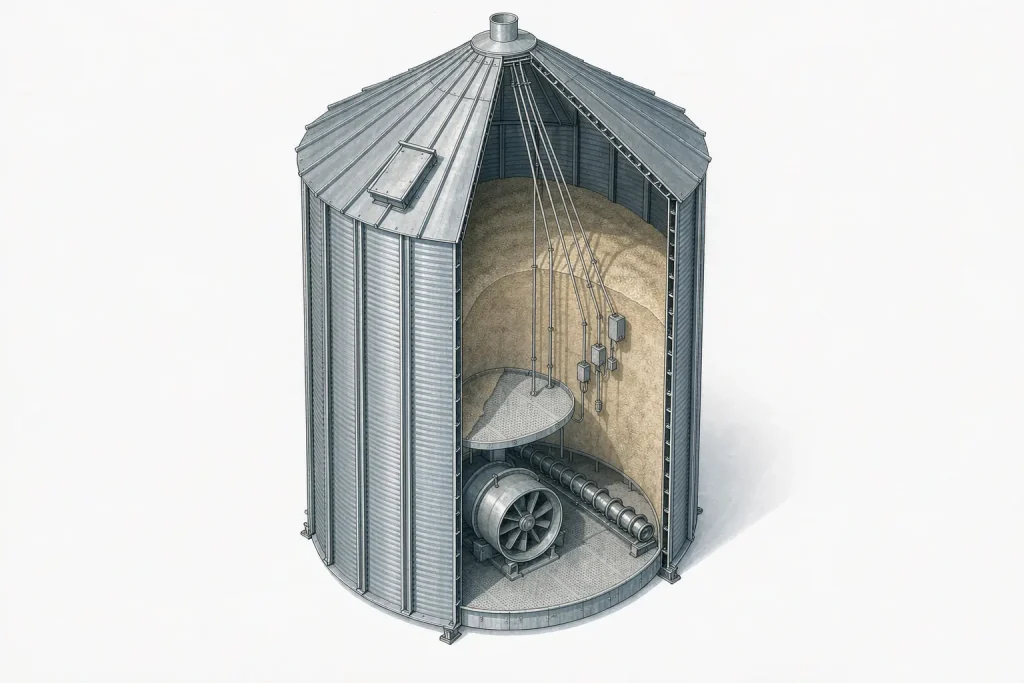
Figure 1. Cutaway of a bolted corrugated steel grain bin showing the roof, sidewall stiffeners, raised perforated floor, aeration fan, sweep auger and suspended temperature cables.
2. What Is a Grain Bin Used For?
- Harvest buffer.Harvesters deliver faster than dryers, trucks or markets can absorb. A bin decouples the two rates so the harvest does not stop.
- Wet-grain holding.Grain above safe moisture can be held briefly before drying, provided it is cooled and turned around quickly.
- Moisture equalisation.After mechanical drying, kernels are not uniformly dry. A rested, aerated lot redistributes moisture and reduces the risk of hot spots.
- Long-term storage.Months of holding while keeping germination, milling quality, test weight and market grade intact.
- Segregation and identity preservation.Separate lots by grain type, variety, moisture, grade or certification status.
- Load-out staging.A metered buffer in front of truck, rail or ship loading, where throughput and scheduling matter more than capacity.
Two quieter uses matter too: a controlled space for fumigation or treatment, and strategic reserve holding. In each case the bin is not the end of the process — it is a scheduling device inside a longer chain.
3. How Does a Grain Bin Work?
A bin manages three variables — moisture, temperature and time — through a small set of subsystems.
| Subsystem | What it does | Why it matters |
| Shell, roof and foundation | Carries lateral grain pressure and keeps weather out | Structural failure and leaks are the most expensive storage faults |
| Perforated floor and aeration fan | Moves ambient air uniformly through the grain | Equalises temperature and prevents moisture migration |
| Temperature cables and moisture sensors | Map conditions at multiple depths, typically 1.5–2 m apart vertically | Detect heating days before it is visible at the surface |
| Level and inventory sensing | Tracks how much is in each bin | Reconciles stock and controls filling |
| Sweep auger and unloading outlet | Empties the residual grain after gravity flow stops | Determines clean-out time and labour |
| Filling, aspiration and dust control | Conveys grain in and captures dust | Dust is both a quality and an explosion hazard |
Aeration is not drying. Aeration moves a small volume of ambient air — commonly 0.1–0.2 cubic feet per minute per bushel for upright storage; University of Georgia guidance gives 1/10 to 1/20 cfm/bu — to equalise temperature. It barely changes moisture content. Drying removes water and needs far more air, on the order of 1.0 cfm/bu for in-bin drying, usually with supplemental heat. Treating a damp lot as if aeration will dry it is the most common way a bin goes wrong.
Temperature is the cheap lever. Below about 4 °C (40 °F) the organisms that spoil stored grain are strongly inhibited, and insect reproduction largely stops below roughly 16 °C (60 °F). That is why autumn aeration is about cooling, not drying.
4. What Are the Main Types of Grain Bins?
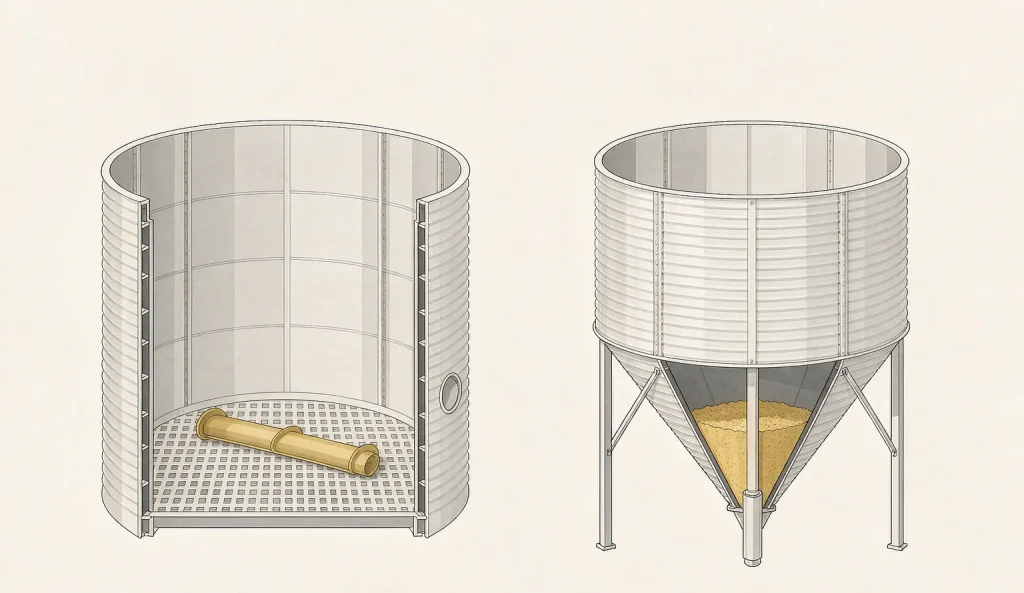
Figure 2. A flat-bottom bin with a perforated floor and sweep auger, left, compared with a hopper-bottom bin that discharges by gravity, right.
| Type | How it empties | Best fit | Trade-off |
| Flat-bottom with full perforated floor | Gravity to a centre sump, then sweep auger | Long-term storage, largest capacities, most uniform aeration | Slower clean-out, more labour, confined-space entry |
| Hopper-bottom | Gravity through a steep cone | Frequent lot changes, short cycles, sticky material | Smaller capacity, needs headroom, cone angle must suit the grain |
| Bolted corrugated steel | Either | Most on-farm and depot storage | Coating and bolt maintenance, corrosion at seams |
| Concrete or smooth-wall steel silo | Gravity, often mass flow | High-throughput terminals, tall silo banks | Higher capital cost, harder to clean and retrofit |
| Temporary or field bin | Gravity | Short harvest buffer | Limited life, limited weather protection |
The flat-versus-hopper decision is really a turnover decision. If a bin is emptied a few times a year, a flat floor with a sweep auger is economical. If it is emptied weekly, the labour and entry risk of clean-out makes a hopper worth the extra height and cost.
5. What Actually Keeps Grain Safe?
Moisture sets the ceiling. Grade standards give upper limits on a wet basis — around 15.5% for maize, 14.5% for wheat, 14% for soybeans and 10% for canola in North American grading guidance — but those are marketing limits, not long-storage targets. For a twelve-month hold, engineers commonly work closer to 13% for maize and 12.5% for wheat. Respiration roughly doubles for every 10 °C rise between 10 °C and 30 °C, so warm, slightly damp grain deteriorates fast.
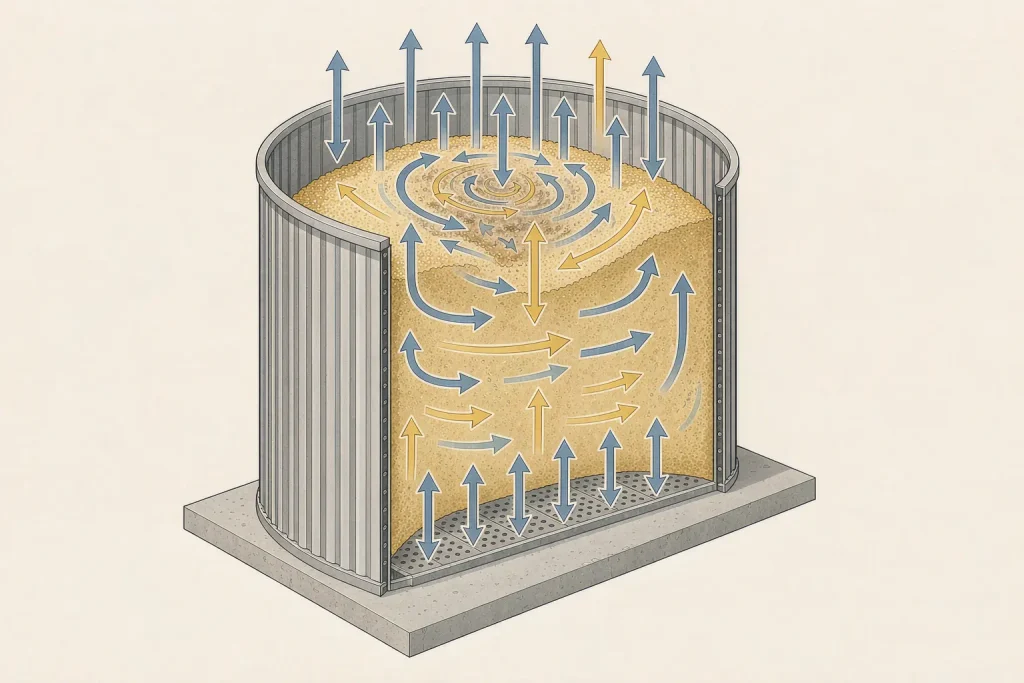
Figure 3. Natural convection inside an unaerated grain mass: warm air rises through the centre, cools near the surface and sinks along the cooler walls, concentrating moisture in the top layer.
Moisture migration is the subtle failure. Grain loaded warm in autumn cools from the outside in. Air near the walls becomes dense and sinks; warmer air in the centre rises, picks up moisture, and condenses when it meets the cool top layer and the underside of the roof. A weather-tight bin can therefore develop a crust of spoiled grain at the top even though the grain went in dry. A uniform aeration front interrupts that convection loop. Broken kernels and fines make it worse by blocking airflow and feeding mould, which is why cleaning before storage is an engineering control, not housekeeping.
Safety is a separate discipline. In the United States, OSHA 29 CFR 1910.272 treats bin entry as a permit-controlled operation: mechanical equipment must be de-energised and locked out, the atmosphere tested (oxygen below 19.5% is a stop condition), “walking down grain” is prohibited, entrants need a body harness and lifeline with an observer outside, and rescue equipment must suit the structure. The same standard sets a 1/8 inch threshold for fugitive grain dust at priority housekeeping areas in elevators; NFPA 61 is the industry reference for dust explosion prevention. These are reference points, not a substitute for the regulations and site procedures that apply to a given facility.
6. Sizing and Selecting a Bin
Capacity is the first number people quote and rarely the one that decides the design. Work through these in order:
- Throughput and turnover— peak intake in tonnes per hour, how many times the bin empties per year, and the load-out rate to trucks, rail or ship.
- Grain and its properties— bulk density (roughly 0.75–0.85 t/m³ for wheat, 0.70–0.75 t/m³ for maize) and angle of repose (about 25–30° for wheat, 20–25° for maize) drive both volume and hopper geometry.
- Moisture and climate— wet harvests need drying capacity and higher airflow; humid or tropical climates need more aeration and closer monitoring.
- Units and reconciliation— a US bushel is a volume unit; conversion to mass depends on the grain (56 lb for maize, 60 lb for wheat), so state which basis a capacity figure uses.
- Site and interfaces— foundation bearing, headroom for filling, conveyor routes, dust collection, and access for clean-out.
- Instrumentation— temperature cables, moisture and CO₂ sensing, level indicators, and whether fan control is manual or automated.
A bin sized only on volume is usually the cheapest component and the most expensive bottleneck.
7. From One Bin to a Complete Handling System
A storage bin sits in the middle of a chain: receiving and sampling → pre-cleaning → weighing → drying → storage with aeration and monitoring → reclaim → load-out. Each arrow has a rate. If the dryer delivers 60 t/h and the intake conveyor handles 40 t/h, the extra capacity of a larger bin changes nothing. This is why storage projects are specified as systems rather than as isolated tanks; the bin is only as good as its slowest neighbour.
8. Common Misconceptions
- “Aeration dries grain.”It equalises temperature and, at best, removes one or two points of moisture very slowly. Drying needs high airflow and usually heat.
- “A sealed, dry bin needs no attention.”A sealed bin still develops temperature gradients and condensation. Monitoring is what makes storage predictable.
- “Bigger is always better.”Oversized bins are harder to aerate uniformly, slower to turn around, and more costly to clean out.
- “Bin, silo and elevator are synonyms.”They describe different structures — and “elevator” often means the whole facility or the lifting machine, not a storage vessel.