

What’s the Difference Between a Grain Bin and a Grain Silo?
Ask a farmer in Iowa and an engineer in Jiangsu the same question and you get two different answers. Both are correct.
In most of the world, a grain bin and a grain silo are the same object under two names: a round structure that holds bulk grain. In North America the words split. “Bin” means the bolted, corrugated galvanized steel tank with a fan on its side, standing in a farmyard or at a country elevator. “Silo” means a tower holding fermented forage, or a cluster of tall concrete or smooth steel cells at a terminal. The language layer explains why quotations go wrong. The engineering layer explains what actually changes the steel.
The short answer
The terms differ in three ways, in order of practical importance:
- Regional and arbitrary. It costs money only when it causes a misunderstanding in an enquiry.
- Bolted corrugated steel, welded smooth steel, or concrete. This sets airtightness, build time and how easily the store can be extended.
- Duty, and therefore structural design.Whether the cell has to dry grain, hold it for nine months under controlled atmosphere, or turn it over weekly.
The name is a label. The duty is the specification.
Where the two words came from
“Silo” entered English around 1835 from the Spanish silo, usually traced through Latin sirum to the Greek siros, a pit for holding grain; a rival etymology points to the Basque zilo, a grain dug-out. The original object was underground and unlined. By 1867 the word meant an airtight cylinder above ground, and it has drifted since, which is why it has also described a missile launch tube.
The forage meaning arrived by a parallel route: ensilage (1875) from the French ensiler, from Spanish ensilar, to put into a silo, with silage following as a shortened form in 1879. Because the fermentation process and the structure evolved together, “silo” in North America attached itself to the fermented feed. That is the root of the confusion buyers still hit.
Why North America splits the words
In the United States and Canada, “grain bin” is the default term for the corrugated galvanized steel tank used to store and dry grain. “Silo” is reserved for tower silos holding silage or haylage, and for the tall concrete or smooth steel cells of a commercial grain elevator. Note the phrasing: a grain elevator is a group of silos, not one.
Elsewhere, in Europe, most of Asia, South America and much of Africa, “silo” is simply the word for a round grain store, corrugated steel included. A buyer in Southeast Asia asking for a “steel grain silo” means exactly what a North American farmer calls a bin. In an enquiry, “silo” is therefore ambiguous in North America and unambiguous almost everywhere else. Specifying for a North American site, write “grain bin” when you mean a corrugated steel tank, and always state what the structure will hold. Exporting, “grain silo” is the safer generic term, and a drawing settles the argument faster than vocabulary.
The three axes that actually differ
| Axis | Grain bin (North American sense) | Grain silo (general sense) | What it changes on site |
| Language | Farm and country-elevator usage in US and Canada | Standard term almost everywhere else | Enquiry clarity, quotation scope, spare-part naming |
| Construction | Bolted corrugated galvanized steel, stiffeners, shallow cone roof | Welded smooth steel or slip-formed concrete, often with conical hoppers | Airtightness, build sequence, extension options |
| Typical duty | On-farm storage, in-bin drying, batch segregation | Terminal and processing storage, high throughput, long holding | Load case, wall thickness, floor and discharge design |
Construction: what the shell is made of
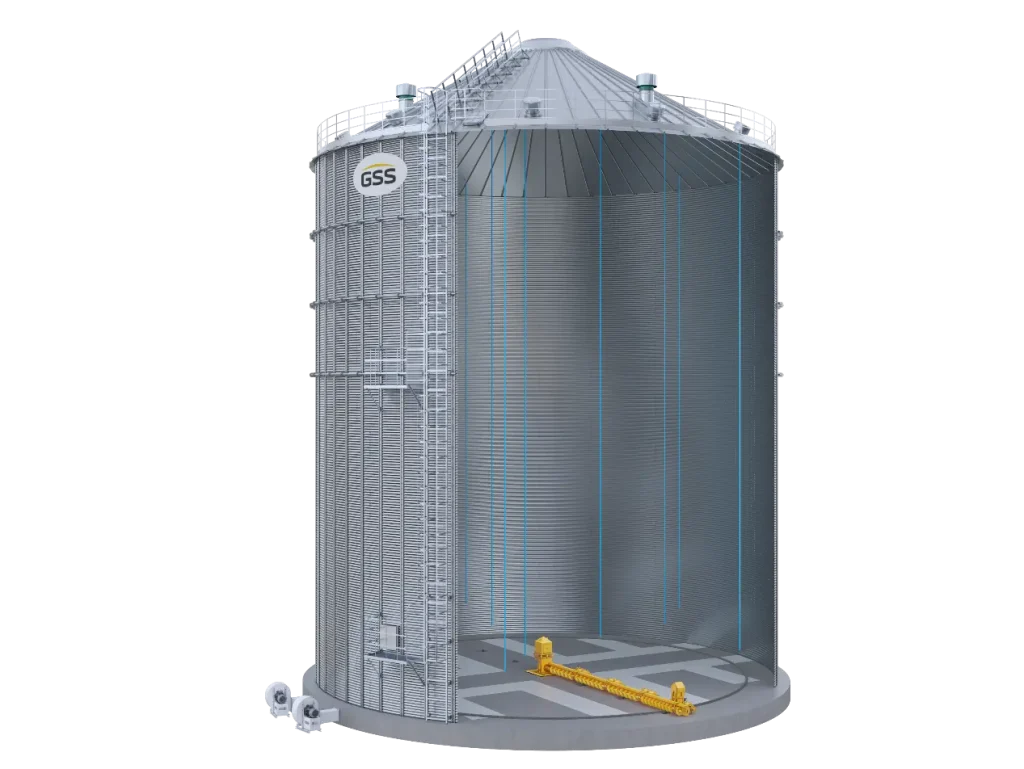
Figure 1. Cross-section of a bolted corrugated galvanized steel grain bin with a shallow cone roof (approx. 28°) and a perforated aeration floor above a plenum.
Bolted corrugated galvanized steel. Sheets with a 2.66-inch or 4-inch corrugation are bolted on site over vertical stiffeners, with a shallow cone roof and, where the store dries grain, a perforated floor above a plenum. Members ship in containers and erect with small crews, which is why this type dominates farm storage. Its weakness is airtightness: every bolt hole and lap is a potential leak, so controlled-atmosphere work needs sealant, gaskets and a pressure test.
Welded smooth-wall steel. Plates are welded on site in rings or by press-forming. Fewer penetrations mean better gas retention and higher load capacity at large diameters, which suits big single cells, fumigation and frequent filling. The trade-off is site quality control: welding, distortion and coating repair all need managing, and the build is slower.
Slip-formed concrete. The shell is cast in a continuous lift around a moving form. Industrial concrete silos commonly fall in the 3 to 27 metre diameter and 9 to 84 metre height range, with conical hoppers feeding a reclaim tunnel. Concrete brings thermal inertia, excellent airtightness and long life, at the price of the longest programme, the highest capital cost and the least flexibility to extend.
Two details matter as much as the material. The roof profile decides how water and snow behave, and hatches and vents are where most water gets in. The base decides everything downstream: a flat floor with a sweep auger behaves very differently from a conical hopper, in emptying and in load path.
The line engineers actually draw: height over diameter
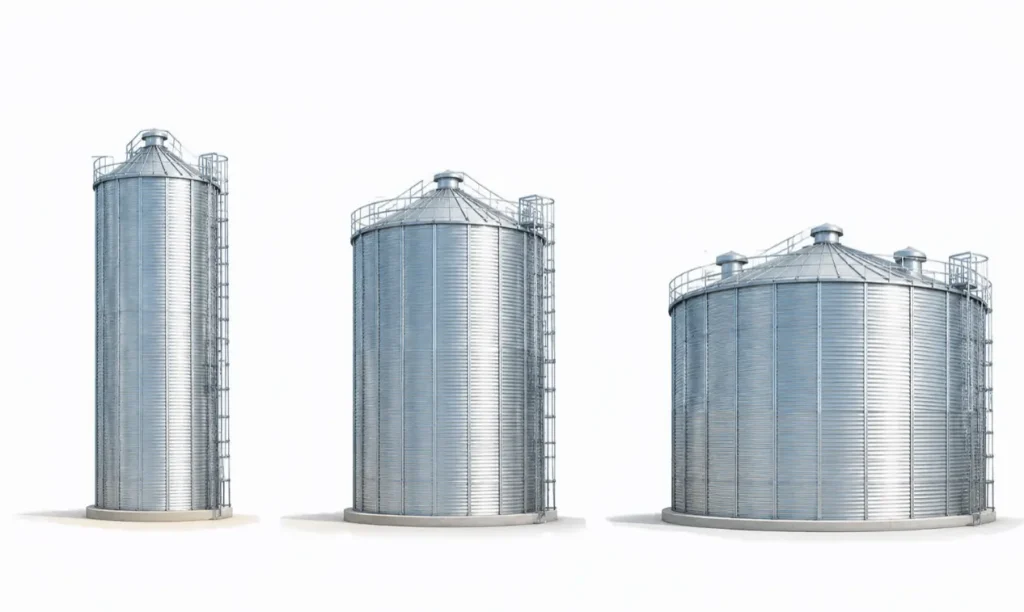
Figure 2. The same stored mass at three aspect ratios. Lateral wall pressure builds towards the base and is strongest in the wide, squat cell on the right, while the tall slender cell on the left carries far more of the load vertically.
Leave the vocabulary behind and the variable that separates one design from another is the aspect ratio: internal height over internal diameter, H/D. The reason is Janssen’s 1895 analysis. Wall friction carries a growing share of the vertical load with depth, so lateral pressure rises fast near the surface and then flattens. A tall cell therefore develops high vertical compression in the wall and modest lateral pressure. A wide, shallow cell has less friction area, so lateral pressure keeps climbing to the base.
That difference drives the whole design. Slender cells are governed by axial compression and are prone to elephant-foot buckling near the base. Squat cells are governed by circumferential tension low down, so they need heavier plate or stronger stiffening even though they look less demanding. European practice formalizes the split, and other standards draw the line elsewhere:
| Standard | Squat / shallow limit | Slender / deep definition |
| EN 1991-4 and DIN 1055-6 | 0.4 ≤ H/D < 1.0 | H/D ≥ 2.0 |
| ISO 11697 | H/D < 1.0 | Governed by stored-depth and wall-friction criteria above the shallow band |
| AS 3774 | Defined by critical depth (z₀) and wall-friction criteria | Defined by stored-depth and wall-friction criteria rather than a fixed H/D ratio |
| ANSI/ASAE S433.1 | H/D ≤ 2.0 for low silos | Above H/D = 2.0 |
The disagreement is not sloppiness: discharge pressures are still predicted from coefficients calibrated against different materials and failure records. The buyer’s lesson is simpler. Ask which standard the design is checked against, and expect wall thickness to follow. Two stores with the same capacity and steel grade can end up with very different shells.
Duty: what each structure is asked to do
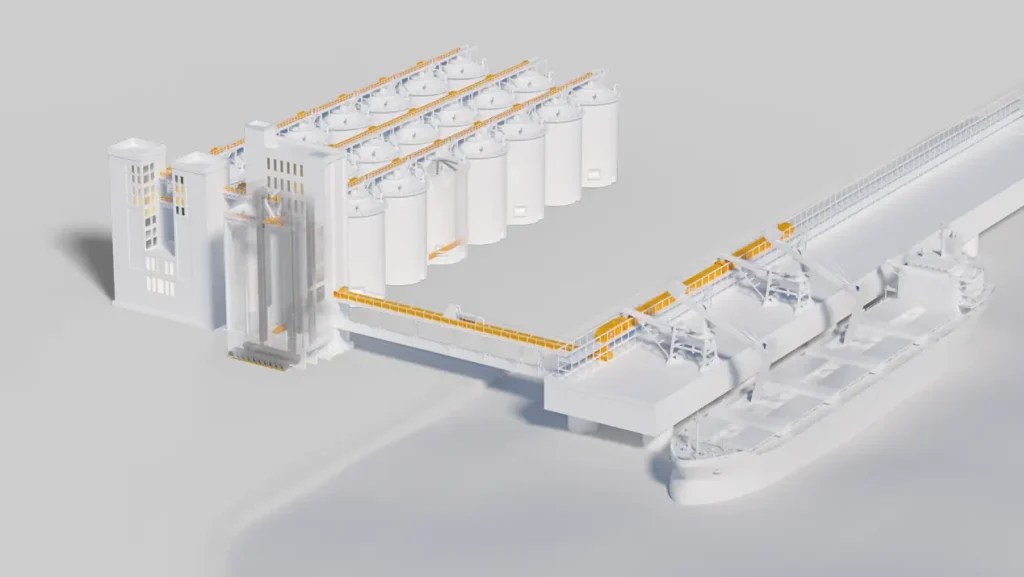
Figure 3. A farm-scale bin setup on the left and a commercial silo terminal on the right. The nouns are often interchangeable; the systems around them are not.
A bin is built around one harvest. It takes grain fast at the peak, holds it at a controlled temperature and empties once or twice before the next crop. It is sized to the farm, added a unit at a time, and its floor and fan are chosen to cool the mass and, where climate allows, finish drying in the bin.
A silo in the terminal sense is built around a flow. It sits inside a chain of receiving pits, cleaners, dryers, conveyors and outloading equipment, and it is judged on throughput and on how little the grain deteriorates between arrival and dispatch. Segregation by grade, moisture and origin drives the number of cells more than total capacity does.
| Item | Bin, farm scale | Silo, terminal scale |
| Typical capacity | Roughly 100 to 15,000 tonnes per unit | Hundreds to tens of thousands of tonnes per cell |
| Turnover | Once or twice a year | Weekly to continuous |
| Drying | Frequently integrated in the bin | Usually, a separate dryer ahead of storage |
| Aeration | Near universal, sized for cooling | Designed per cell, often automated |
| Discharge | Flat floor with sweep auger, or hopper | Multiple hoppers into a reclaim tunnel, or sweep systems |
| Expansion | Add units as the farm grows | Planned once, with the conveying gallery |
| Governing risk | Moisture and temperature in a slow-moving mass | Throughput bottlenecks and quality loss on transfer |
Six questions that settle the choice
- Who operates it?One harvest and two operators favor bins. Shifts, a weighbridge and a dispatch desk favor larger cells in a planned block.
- Must it dry, or only hold?In-bin drying needs a perforated floor, enough static pressure and roughly ten times the airflow used for cooling alone.
- What is the turnover?Slow turnover rewards airtightness, thermal mass and monitoring. Fast turnover rewards large outlets and minimal dead stock.
- Is controlled atmosphere or fumigation required?Then airtightness is a requirement, not a wish, and welded steel or concrete start ahead.
- How will grain leave?A sweep auger leaves a residual heel and needs a person or machine on the floor. Hoppers discharge by gravity but cost height and steel.
- How will the site grow?Phased expansion favors bolted bins. Silo blocks are cheaper per tonne only if the gallery and foundations are planned for the final layout from day one.
Five things people get wrong
“Bins are only for farms.” Large corrugated bins run in commercial depots, feed mills and ports.
“Silos are concrete.” A large share of the world’s grain silos are welded or bolted steel.
“A silo is a silage tower.” That is one North American usage. In most markets a silo holds dry grain.
“If it is tall, it is a silo.” A 30-metre corrugated bin is still a bin.
“The words are interchangeable, so the drawings are too.” Swap the words in conversation if you like. Do not swap the load cases in the calculation.
Where this fits with our first guide
For the basics — what a bin is, what it is used for, how aeration differs from drying, and what keeps a stored mass alive or dead — read What Is a Grain Bin, and What Is It Used For? That guide covers the internal systems. This one only settles the vocabulary and the design rules behind it.
Quick Facts
| Question | Short answer |
| Same object? | Usually yes, in most markets. In North America, partly no. |
| Root of the split | “Silo” attached to silage and to concrete tower stores in US and Canadian usage |
| Real engineering divider | Aspect ratio H/D, not the name |
| Squat definition | 0.4 ≤ H/D < 1.0 under EN 1991-4 |
| Slender definition | H/D ≥ 2.0 under EN 1991-4 |
| Most common material | Galvanized corrugated steel, bolted on site |
| Best airtightness | Welded steel or slip-formed concrete |